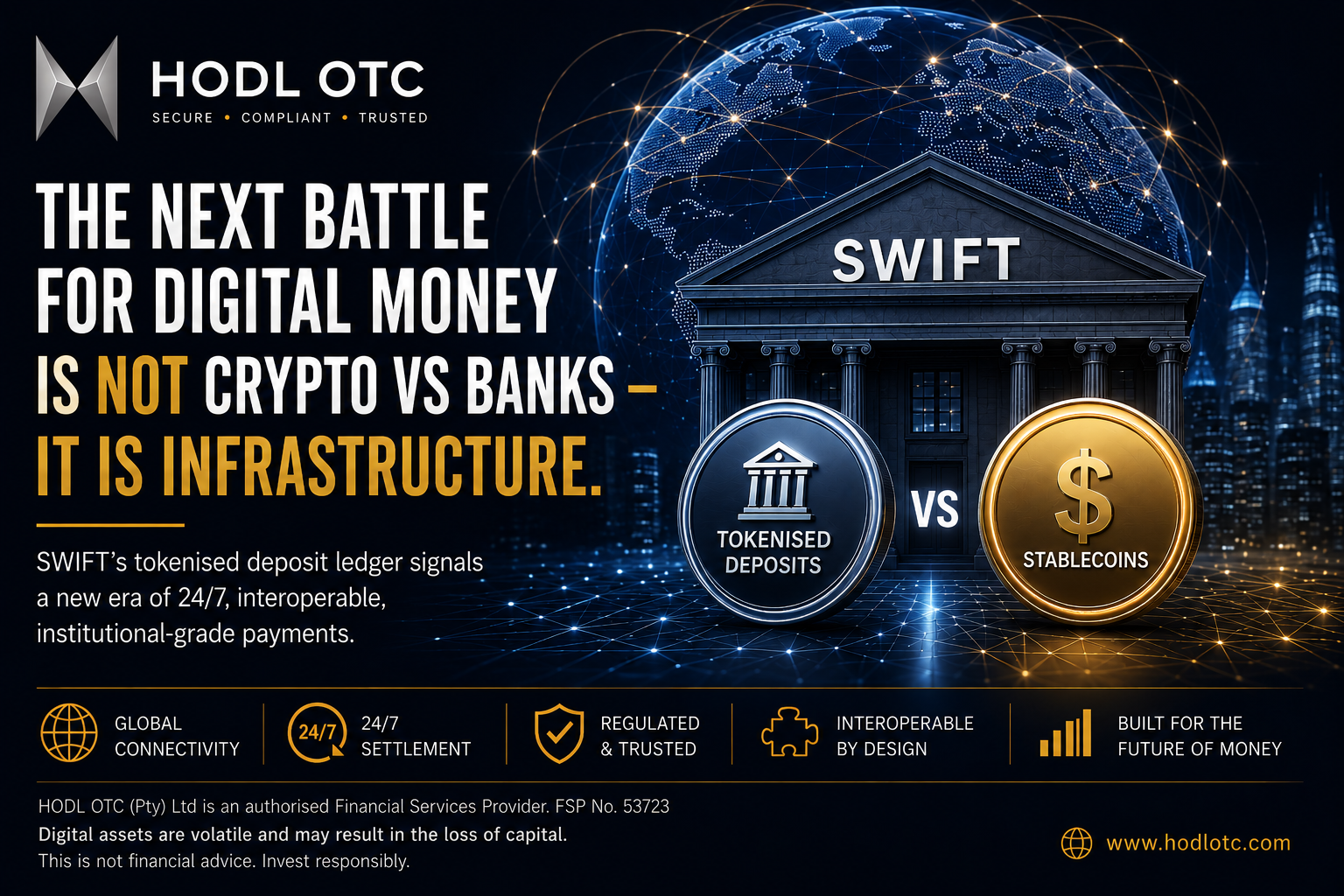
The Next Battle for Digital Money Isn’t Crypto vs Banks — It’s Infrastructure
What SWIFT’s Tokenised Deposit Ledger Means for Stablecoins, Banks and the Future of Global Payments
By HODL OTC
For years, the digital asset conversation has largely been framed as a competition.
Bitcoin versus traditional finance.
Stablecoins versus banks.
Blockchain versus legacy infrastructure.
But the latest move by SWIFT suggests the future may look very different.
Rather than replacing the existing financial system, blockchain technology is increasingly being incorporated into it.
In July 2026, SWIFT announced that its blockchain-based shared ledger was ready for initial use, with 17 banks across six continents preparing to pilot live transactions using tokenised deposits. The objective is straightforward but significant: enable 24/7 cross-border payments while improving liquidity visibility and reducing friction between financial institutions.
This raises a much bigger question: If banks can tokenise deposits and move value through shared blockchain infrastructure, where does that leave stablecoins?
The answer is more nuanced than a simple winner-takes-all narrative. The evolution of money is becoming an infrastructure story
Traditional international payments have historically relied on a network of banks, correspondent relationships, messaging systems, settlement processes and operating hours.
SWIFT has been at the centre of that infrastructure for decades. Its new approach is not about abandoning that system. It is about upgrading it.
SWIFT describes the new ledger as a shared orchestration layer that can coordinate interbank payment commitments using tokenised deposits. Banks retain control over their assets, funding and keys, while settlement can continue through existing infrastructure.
That distinction is important. The blockchain is not necessarily replacing the bank. It is becoming another layer of the bank and that may ultimately be one of the most important developments in digital finance.
Tokenised deposits vs stablecoins:
At a high level, both tokenised deposits and stablecoins attempt to solve a similar problem:
How do you represent value digitally so that it can move more efficiently?
But they approach the problem differently. A tokenised bank deposit essentially represents a claim on commercial bank money within a regulated banking relationship.
A stablecoin, depending on its structure and issuer, represents a digital token designed to maintain a stable value against an underlying reference asset, commonly a fiat currency.
The difference is therefore not simply technological. It is about who issues the money, where the liability sits, how it is regulated, how it moves and who can access it.
This distinction could become increasingly important as financial institutions move deeper into tokenisation.
Why stablecoins aren’t going away:
It would be easy to look at SWIFT’s development and conclude that stablecoins have suddenly become obsolete. We don’t believe that is the right conclusion.
Stablecoins have already demonstrated that there is significant demand for digital representations of fiat value that can operate across blockchain networks.
Their strength lies partly in their flexibility. They can potentially move outside traditional banking hours, interact with blockchain-based applications and connect different parts of the digital asset ecosystem.
Tokenised deposits, by contrast, are likely to be deeply connected to the existing banking system. That doesn’t necessarily make one better than the other. It may make them different pieces of the same future financial architecture.
The real opportunity is interoperability:
The most important word in SWIFT’s recent announcements may not be “blockchain”. It may be interoperability. SWIFT has repeatedly highlighted the importance of connecting existing financial infrastructure with emerging digital networks. Its shared ledger is being developed to work with banks’ tokenised deposits while maintaining compatibility with existing payment applications and standards.
This matters because the future financial system is unlikely to operate on a single blockchain, a single stablecoin or a single settlement asset. Instead, we could see an ecosystem containing:
- Commercial bank deposits
- Tokenised bank deposits
- Stablecoins
- Central bank digital currencies
- Tokenised securities
- Traditional payment rails
- Blockchain networks
- Institutional settlement infrastructure
The competitive advantage will increasingly belong to the infrastructure that can connect these systems securely and efficiently. From “digital assets” to “digital money” This is where the conversation becomes particularly interesting for investors and businesses. The first phase of digital assets was largely about creating new assets. The next phase could be about digitising the financial infrastructure around existing assets and money.
That is a very different proposition. When one of the world’s most important financial messaging networks begins integrating blockchain infrastructure into its own stack, it sends a powerful signal:
Blockchain is no longer simply an alternative financial system being built outside traditional finance. It is becoming part of the infrastructure being built inside traditional finance.
SWIFT says its network connects more than 11,500 institutions across more than 200 countries and territories, making its move particularly significant from an infrastructure perspective.
What does this mean for South Africa?
For South African businesses, investors and financial institutions, these developments deserve attention. South Africa is already developing a regulatory framework around crypto assets and digital financial services, while the country’s financial sector remains deeply connected to international payment networks.
As global institutions move toward tokenised money and 24/7 settlement, the implications could eventually extend beyond crypto markets. Consider cross-border trade. A South African business purchasing goods internationally could eventually operate in an environment where the movement of value, foreign exchange and settlement information becomes increasingly digital, automated and close to real time. For businesses operating across borders, improvements in settlement speed and liquidity management could become more important than the underlying technology itself.
The technology becomes the infrastructure.
The bigger picture for investors:
There is another lesson here. The digital asset market should not be viewed solely through the lens of token prices. Some of the most consequential developments may be happening underneath the market.
Payment infrastructure.
Custody.
Tokenisation.
Settlement.
Liquidity.
Compliance.
Interoperability.
These are the foundations upon which the next generation of financial services could be built.
For investors, that means understanding the broader digital asset ecosystem is becoming increasingly important.
The question is no longer simply:
“Which digital asset will win?”
A better question may be:
“Which infrastructure will allow digital value to move at global scale?”
Our HODL view:
At HODL OTC, we believe the most interesting part of this development is not that SWIFT is “competing with crypto.” It is that the lines between traditional finance and digital finance are becoming increasingly difficult to draw.
The future is unlikely to be completely decentralised. It is also unlikely to remain entirely dependent on legacy infrastructure.
Instead, we are moving towards a financial environment where regulated institutions, blockchain networks, tokenised money and digital assets interact with one another.
SWIFT’s shared ledger is another indication that this transition is moving from experimentation toward infrastructure and that changes the conversation.
The next chapter of digital finance may not be about replacing the financial system. It may be about rebuilding the financial system so that money can move with the speed, programmability and connectivity of the digital world.
For businesses and investors, that is a development worth watching closely. The rails are changing. The question is who will be riding on them.
About HODL OTC:
HODL OTC (Pty) Ltd (FSP 53723) is a South African cryptocurrency-based wealth services provider and an Authorised Financial Services Provider regulated by the Financial Sector Conduct Authority (FSCA). We specialise in over-the-counter (OTC) cryptocurrency trading, offering a secure, compliant and professional environment for digital asset transactions. Our services are designed to support wealth-oriented clients with efficient execution, deep liquidity and a strong focus on regulatory alignment within the evolving digital asset landscape.
Risk Warning:
Crypto assets are high-risk and can be volatile. Investors should be aware that values may fluctuate, and past performance is not indicative of future results. This content is for general information only and does not constitute financial, investment, tax, or legal advice. Clients should assess whether crypto assets are suitable for their financial circumstances and objectives.
Stay Connected with HODL OTC:
Access market insights, track your digital asset activity, and stay informed on the go. Download the HODL OTC app today:
Sources:
Visit us on www.hodlotc.com
Call or WhatsApp us on 066 560 1607
Join our Social Media Pages:
