
Stablecoins Are Becoming the Backbone of Global Payments
Financial markets are continuously evolving as technological innovation reshapes the way value moves across the global economy. Within the digital asset ecosystem, one of the most significant developments in recent years has been the rapid growth of stablecoins and the regulatory attention that has followed.
Stablecoins are digital assets designed to maintain a relatively stable value by being pegged to traditional currencies such as the US dollar. Initially developed to provide traders with a stable medium of exchange within cryptocurrency markets, stablecoins have grown into a critical component of digital asset infrastructure.
As their adoption has expanded across trading platforms, decentralised finance and cross-border payments, regulators around the world have increasingly recognised the need to establish clear legal frameworks governing their use.
The result is a global regulatory shift that is gradually moving stablecoins from a loosely defined crypto asset category into a more structured and supervised financial product.
The Growing Role of Stablecoins in Financial Markets:
Stablecoins have become one of the most widely used instruments within the cryptocurrency ecosystem. They allow market participants to move capital quickly between trading platforms while maintaining price stability relative to fiat currencies.
Over time, their role has expanded far beyond simple trading tools. Stablecoins are now used in decentralised finance applications, blockchain-based lending platforms, remittance systems and cross-border settlement networks.
As the scale of activity has increased, policymakers have begun examining how stablecoins interact with the broader financial system.
Regulators are particularly focused on questions such as reserve backing, transparency of assets, operational risk and the potential impact that large stablecoin issuers could have on financial stability.
These concerns have accelerated the development of regulatory frameworks designed to improve oversight and ensure that stablecoins operate within clearly defined financial standards.
Global Stablecoin Market Growth:
The expansion of the stablecoin market has been one of the fastest growing segments of the broader digital asset industry.
Over the past several years, the total value of stablecoins in circulation has increased significantly as trading activity, decentralised finance and blockchain-based payment systems have expanded.
This growth has attracted increased attention from regulators who recognise that stablecoins are no longer a niche component of cryptocurrency markets but instead represent a meaningful layer of global financial infrastructure.
As stablecoin adoption continues to grow, regulatory clarity has become an important priority for governments seeking to balance innovation with financial stability.
The United States: The GENIUS Act:
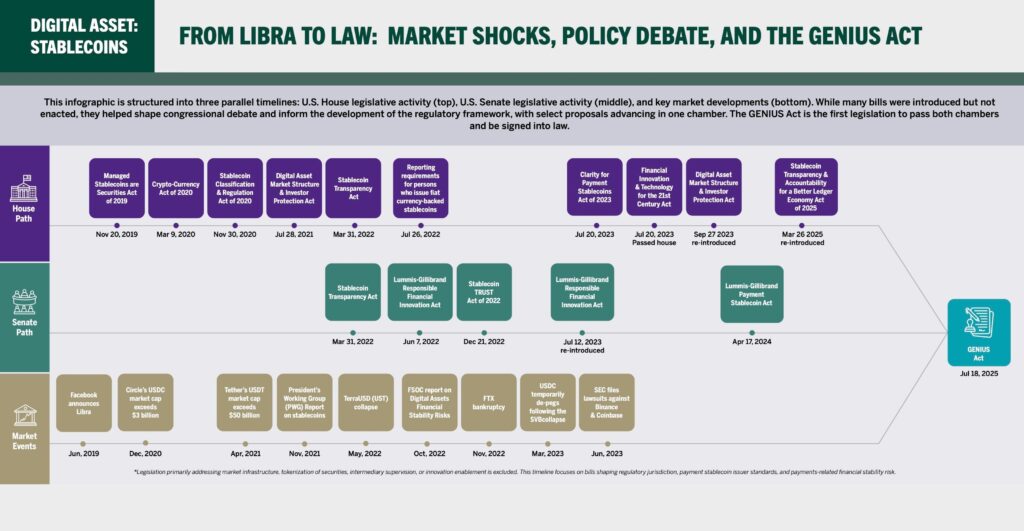
One of the most significant regulatory developments has emerged in the United States with the introduction of the Guiding and Establishing National Innovation for U.S. Stablecoins Act, commonly referred to as the GENIUS Act.
The legislation aims to create a federal framework for stablecoin issuance and oversight, addressing several areas that regulators consider critical to maintaining trust in the financial system.
Key provisions of the proposed framework include:
- 1:1 reserve backing requirements for stablecoins
• Mandatory transparency and auditing standards for reserve assets
• Licensing requirements for issuers operating within the United States
• Supervision by financial regulators
The objective of these requirements is to ensure that stablecoins maintain sufficient liquidity and transparency while protecting market participants from potential risks associated with poorly managed reserves.
If implemented fully, the legislation could mark a significant step toward integrating stablecoins more formally into the traditional financial system.
Regulatory Momentum Across Global Markets:
The movement toward stablecoin regulation is not limited to the United States. Governments across Asia, Europe and emerging markets are also developing their own regulatory frameworks.
In South Korea, policymakers have signalled plans to introduce stricter regulations governing digital asset platforms and stablecoin issuance as part of a broader effort to strengthen oversight within the country’s cryptocurrency sector.
Meanwhile Thailand has taken steps to allow certain stablecoins to be traded on regulated digital asset exchanges, reflecting a growing willingness to integrate digital assets into the formal financial system under appropriate supervision.
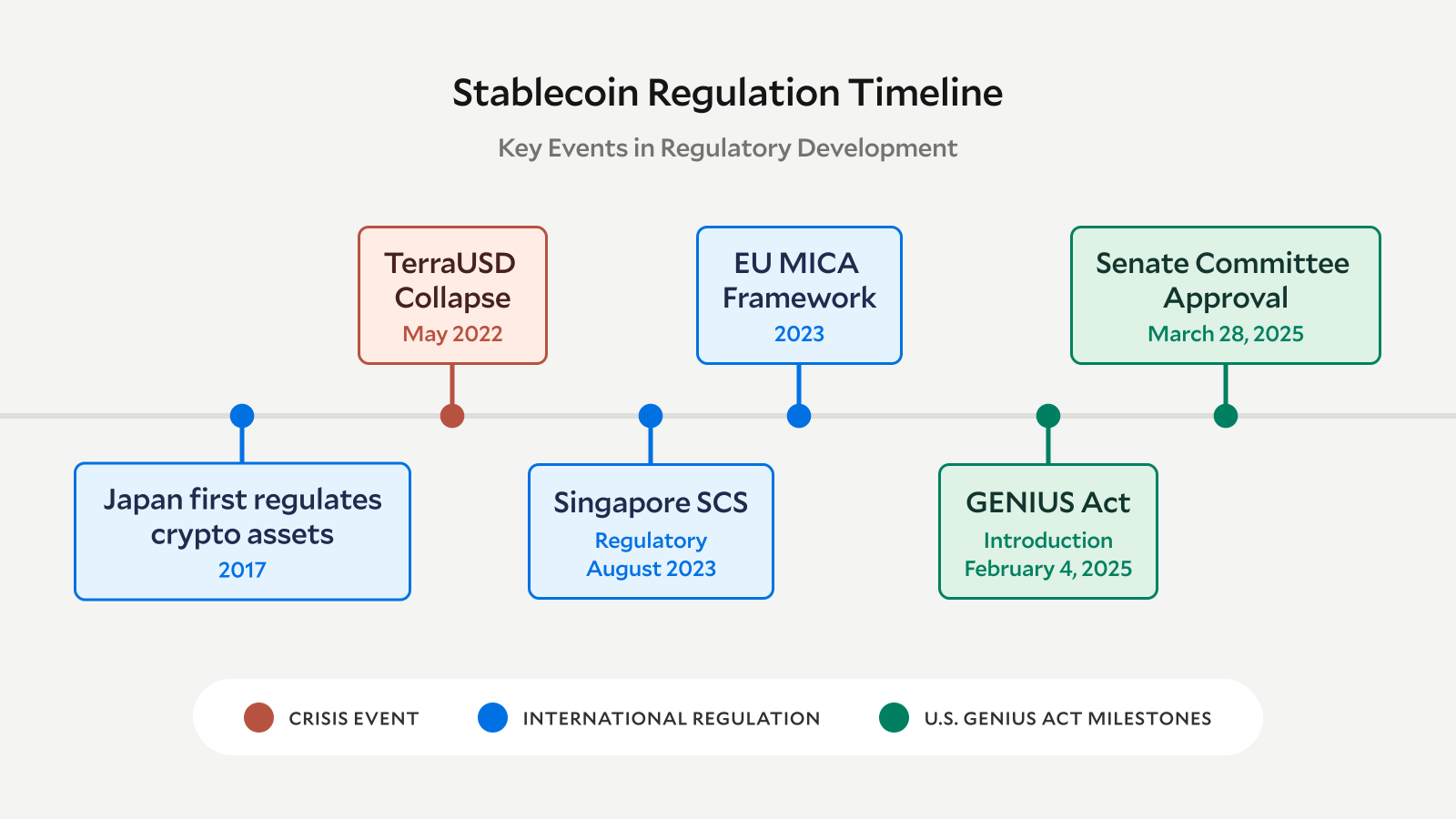
Across the European Union, the implementation of the Markets in Crypto‑Assets Regulation (MiCA) has created one of the world’s most comprehensive regulatory frameworks for digital assets, including stablecoins.
While each jurisdiction approaches regulation differently, the broader trend is clear: governments are working to establish transparent rules that allow innovation while maintaining safeguards for investors and financial institutions.
Why Regulation Matters for Digital Asset Markets:
Clear regulatory frameworks can have important implications for the development of digital asset markets.
During the early years of cryptocurrency adoption, regulatory uncertainty often created challenges for businesses and investors seeking to participate in the sector. Unclear rules around licensing, custody and reserve backing made it difficult for many traditional financial institutions to engage with digital assets.
As regulatory clarity improves, institutions may feel more comfortable exploring blockchain-based payment systems, digital asset trading and tokenised financial products.
In this sense, regulation can serve both as a safeguard and as a catalyst for broader adoption.
However, regulation also introduces new compliance requirements that issuers and service providers must meet. These obligations may include stricter reporting standards, capital requirements and ongoing regulatory supervision.
Balancing innovation with oversight will likely remain one of the key challenges facing policymakers in the years ahead.
The Transition from Crypto Experiment to Financial Infrastructure:
The emergence of stablecoin regulation highlights a broader transformation within the digital asset industry.
What began as an experimental financial technology has evolved into a sector that now interacts with global payment systems, institutional capital markets and national regulatory frameworks.
Stablecoins illustrate this transition clearly. They have moved from being niche tools used primarily by cryptocurrency traders to becoming important infrastructure supporting liquidity across digital markets.
As regulators continue to refine legal frameworks, stablecoins may increasingly resemble traditional financial instruments operating within supervised environments.
For market participants, understanding this transition is essential for navigating the next phase of digital asset market development.
Last Thoughts:
The global push toward stablecoin regulation represents a defining moment in the evolution of the digital asset ecosystem.
Governments are increasingly recognising that stablecoins have grown beyond their origins as simple trading tools and now play an important role within digital financial infrastructure.
Legislation such as the GENIUS Act in the United States, alongside regulatory initiatives in Asia and Europe, reflects a broader effort to establish consistent standards for transparency, reserve backing and market supervision.
As these frameworks develop, stablecoins may continue their transition from operating in a regulatory grey zone toward becoming fully integrated components of the global financial system.
For investors and market participants, monitoring these regulatory developments will be an important part of understanding the long-term direction of digital asset markets.
About HODL OTC:
HODL OTC (Pty) Ltd (FSP 53723) is a South African cryptocurrency-based wealth services provider and an Authorised Financial Services Provider regulated by the Financial Sector Conduct Authority (FSCA). We specialise in over-the-counter (OTC) cryptocurrency trading, offering a secure, compliant and professional environment for digital asset transactions. Our services are designed to support wealth-oriented clients with efficient execution, deep liquidity and a strong focus on regulatory alignment within the evolving digital asset landscape.
Risk Warning:
Crypto assets are high-risk and can be volatile. Investors should be aware that values may fluctuate, and past performance is not indicative of future results. This content is for general information only and does not constitute financial, investment, tax, or legal advice. Clients should assess whether crypto assets are suitable for their financial circumstances and objectives.
Stay Connected with HODL OTC:
Access market insights, track your digital asset activity, and stay informed on the go. Download the HODL OTC app today:
Sources:
https://www.congress.gov/bill/118th-congress/house-bill/4766
https://www.bis.org/publ/bisbull91.htm
https://www.imf.org/en/Publications/fintech-notes/Issues/2023/Stablecoins-regulation
https://www.fsb.org/2023/07/regulation-supervision-and-oversight-of-global-stablecoin-arrangements/
Visit us on www.hodlotc.com
Call or WhatsApp us on 066 560 1607
Join our Social Media Pages:
