
Why Crypto Becomes the Payment Method During Sanctions and Wars
For years, crypto has been discussed mainly as an investment story. In sanctioned economies and conflict zones, though it often becomes something more practical: A way to move value when normal payment rails are strained, restricted or too slow to rely on. The IMF notes that stablecoins are increasingly used as cross-border payment instruments and can be useful where domestic finance is weak or when international transactions are constrained by capital controls or externally imposed sanctions. The BIS also says cross-border payments remain more costly, slower, less accessible and less transparent than domestic payments.
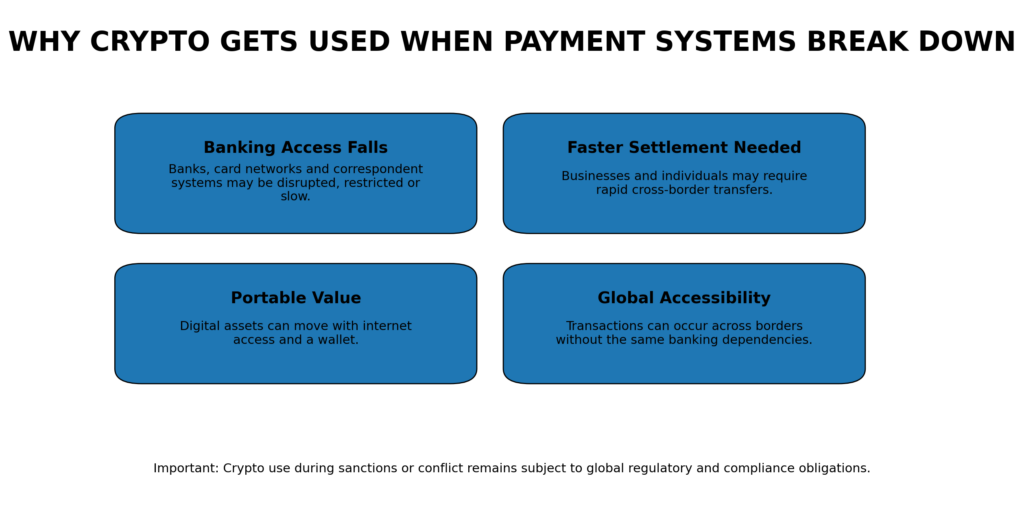
That is the core reason crypto appears again and again in periods of sanctions and war. It is not because it is “better” in every sense. It is because it can be available when banks are disrupted, correspondent channels are restricted or speed matters more than legacy infrastructure can deliver. In fragile or conflict-affected settings the World Bank says crypto assets can facilitate payments, including humanitarian payments, where banking and payments infrastructure is weak or severely disrupted.
Why this happens:
Crypto tends to be used in these environments for a few simple reasons.
It can move across borders without relying on the same layers of intermediaries that traditional payment systems use. It can settle faster than many legacy international transfers. It can be accessed with a wallet and internet connection, even when local systems are under pressure. And in the case of dollar-linked stablecoins, it can provide a more familiar unit of account than a volatile local currency.
That does not make it a free pass. It makes it a high-risk tool operating in a high-friction environment. The same features that make crypto attractive in disrupted settings also make it closely watched for AML, CFT, and sanctions risks. The BIS has highlighted the need for consistent regulatory approaches because new payment instruments can also be exploited to disguise illegal proceeds or finance terrorism.
Market context:
The real-world examples are already visible. The World Bank says Ukraine received more than US$200 million in crypto asset donations for humanitarian relief and defense. Reuters has also reported that Russian companies began using bitcoin and other digital currencies in international payments after legislative changes, and that pro-Russia groups have raised more than $8.3 million in crypto donations since the invasion began, with funds linked to drone purchases.
At the same time, enforcement is adapting. Reuters has reported on sanctions pressure, wallet blocking, and growing scrutiny of crypto-linked networks tied to conflict financing. That shows the same point from another angle: crypto can be usable in restricted environments, but it is not invisible, and it is not outside the reach of compliance systems.
Why this shift matters:
This is not really a story about crypto replacing money. It is a story about payment resilience. When sanctions or war break normal financial links, people and businesses look for rails that are fast, portable and available. That is why crypto can become a practical payment method in the short term, especially for cross-border transfers, humanitarian flows and urgent settlement needs. But as the IMF and BIS both make clear, the longer-term conversation is about efficiency, stability, compliance and the design of safer payment infrastructure.
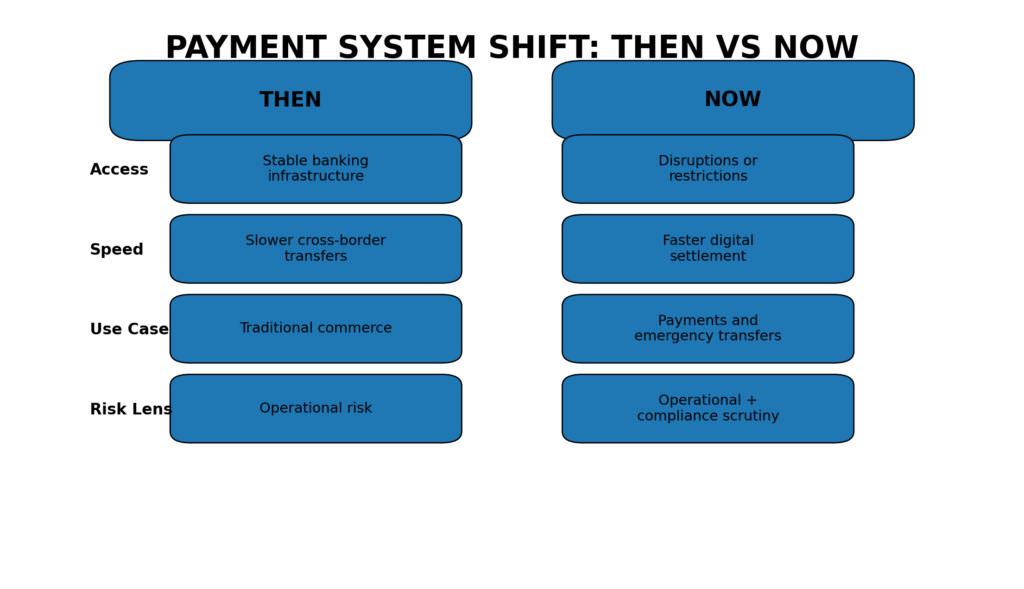
Visualising the shift:
Then: traditional rails, slower transfers, more intermediaries and heavier dependence on local banking. Now: digital portability, faster settlement, and broader access, but also stronger compliance scrutiny and higher legal risk.
Last thoughts:
Crypto becomes the payment method of choice during sanctions and wars for one main reason: access. When access to banks, correspondent networks, or stable local currency weakens, digital assets can fill part of the gap. The trade-off is equally important. Faster movement does not remove legal restrictions, and it does not remove the need for proper controls. In other words, crypto may help value move, but it does not remove the responsibility to stay compliant.
About HODL OTC:
HODL OTC (Pty) Ltd (FSP 53723) is a South African cryptocurrency-based wealth services provider and an Authorised Financial Services Provider regulated by the Financial Sector Conduct Authority (FSCA). We specialise in over-the-counter (OTC) cryptocurrency trading, offering a secure, compliant and professional environment for digital asset transactions. Our services are designed to support wealth-oriented clients with efficient execution, deep liquidity and a strong focus on regulatory alignment within the evolving digital asset landscape.
Risk Warning:
Crypto assets are high-risk and can be volatile. Investors should be aware that values may fluctuate, and past performance is not indicative of future results. This content is for general information only and does not constitute financial, investment, tax, or legal advice. Clients should assess whether crypto assets are suitable for their financial circumstances and objectives.
Stay Connected with HODL OTC:
Access market insights, track your digital asset activity, and stay informed on the go. Download the HODL OTC app today:
Sources:
International Monetary Fund (IMF) — Crypto, Stablecoins and Cross-Border Payments https://www.imf.org/en/Publications/fandd/issues/2025/09/crypto-cross-border-payments
Bank for International Settlements (BIS) — Cryptoassets and Global Financial Stability https://www.bis.org/publ/bppdf/bispap166.htm
*World Bank — Crypto Assets in Fragile and Conflict-Affected Situations https://documents.worldbank.org/en/publication/documents-reports/documentdetail/099082025110025249
*Reuters — Russian companies use bitcoin and crypto for international payments https://www.reuters.com/business/finance/russian-companies-use-bitcoin-crypto-international-payments
*Chainalysis — Crypto and Sanctions Report https://www.chainalysis.com/reports/crypto-sanctions-report
Financial Action Task Force (FATF) — Virtual Assets Red Flag Indicators of Sanctions Evasion https://www.fatf-gafi.org/publications/virtualassets/documents/virtual-assets-red-flag-indicators.html
Visit us on www.hodlotc.com
Call or WhatsApp us on 066 560 1607
Join our Social Media Pages:
