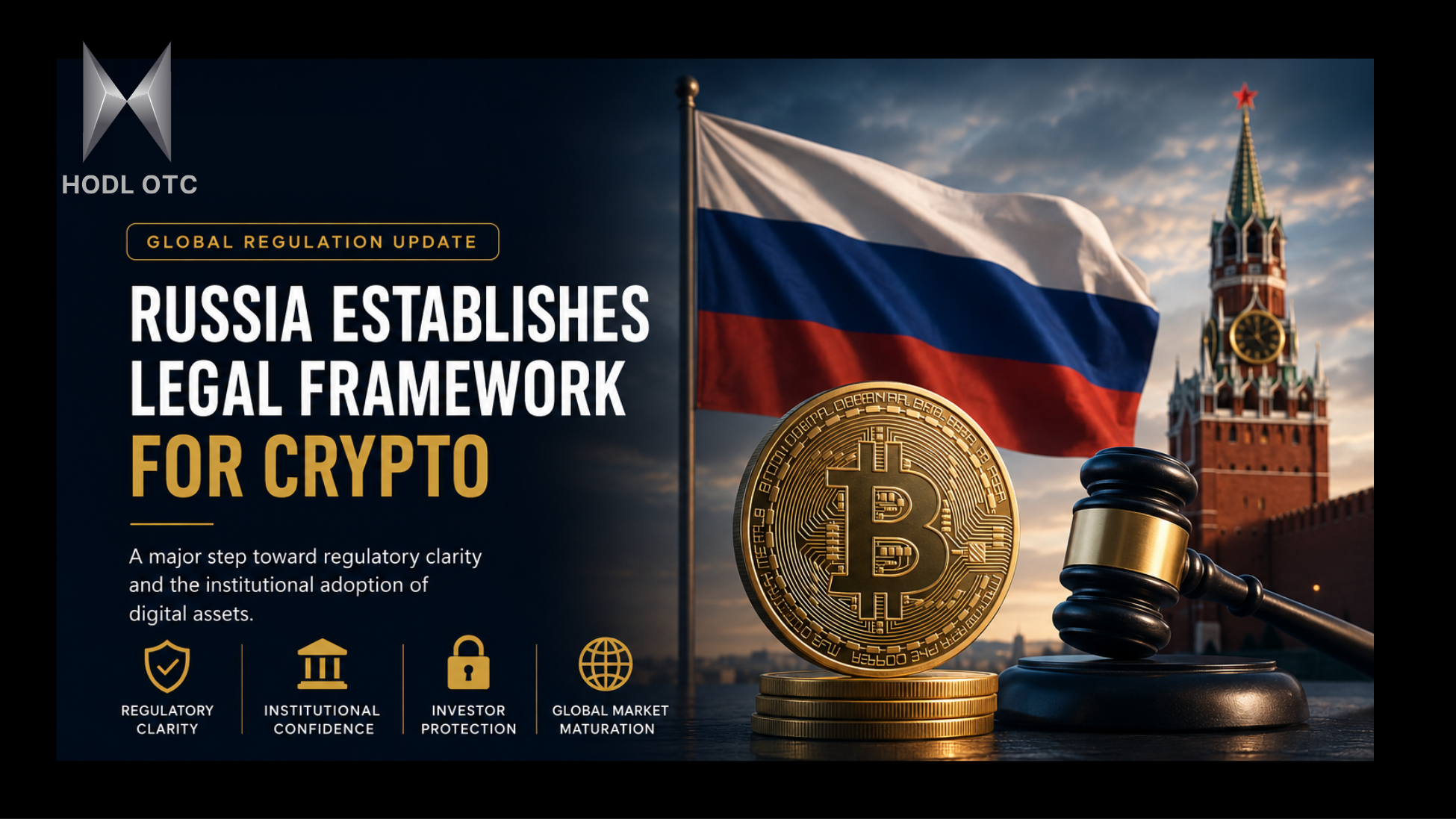
Why Russia Is Regulating Digital Assets: The Geopolitical Strategy Behind Moscow’s Biggest Financial Shift
By HODL OTC
Russia’s new digital asset legislation is not about embracing Bitcoin it is about strengthening financial sovereignty, modernising capital markets and preparing for a changing global financial order.
Why Russia’s New Digital Asset Law Matters More Than Most Investors Realise
In global finance, regulation is rarely just about regulation.
When one of the world’s largest economies fundamentally changes its approach to digital assets, investors should ask a deeper question:
Why now?
Russia’s State Duma has approved the country’s most comprehensive digital asset legislation to date, creating a legal framework for exchanges, brokers, custodians and other digital asset service providers under the oversight of the Bank of Russia. The law also continues to prohibit cryptocurrencies from being used as domestic legal tender while creating regulated pathways for investment and cross-border activity.
On the surface, this appears to be another crypto regulation story.
In reality, it is a story about economic resilience, geopolitical strategy, capital markets and the future of global finance.
Russia Has Completely Changed Its Position
Only a few years ago, Russia’s central bank advocated banning cryptocurrency altogether, arguing that digital assets threatened financial stability.
Today, Russia is building one of the most comprehensive regulatory frameworks for digital assets anywhere in the world.
That change is significant.
Governments rarely reverse policy unless the strategic benefits begin to outweigh the perceived risks.
Russia has clearly concluded that digital assets are no longer a speculative niche—they are becoming critical financial infrastructure.
The Real Reason: Financial Sovereignty
The single biggest reason behind Russia’s regulatory shift is financial sovereignty.
Following sanctions imposed after the invasion of Ukraine, Russia’s access to Western financial infrastructure became significantly constrained.
Restrictions affecting SWIFT access, correspondent banking relationships and international payment channels forced policymakers to accelerate alternative settlement mechanisms.
Digital assets offer several advantages:
- Borderless settlement
- 24-hour global markets
- Reduced reliance on correspondent banking
- Programmable financial infrastructure
- Faster cross-border transfers
This does not mean cryptocurrencies replace traditional banking.
Rather, they provide governments and businesses with an additional settlement rail that operates independently from legacy payment infrastructure.
Russia has already permitted digital assets for certain international trade settlements, and its new legislation builds the regulatory infrastructure around those activities.
The Shadow Market Was Already There:
One misconception surrounding regulation is that governments create digital asset markets.
They don’t.
Markets already exist.
Governments simply decide whether those markets operate:
- Outside regulatory oversight, or
- Inside a supervised financial framework.
Russia has chosen the second option.
Licensing exchanges, brokers and custodians allows authorities to monitor transactions, strengthen anti-money laundering controls, improve tax compliance and provide legal certainty for market participants.
History has repeatedly shown that banning financial innovation is far more difficult than regulating it.
The Numbers Explain Why Regulation Became Inevitable:
Russia is already one of the world’s largest digital asset economies.
According to Chainalysis, Russia ranks among the world’s leading countries for cryptocurrency adoption and transaction activity.
More broadly:
- Eastern Europe processed approximately US$499 billion in on-chain digital asset value between July 2023 and June 2024.
- The region represented roughly 11% of global cryptocurrency transaction volume during that period.
- Russia accounted for one of the largest shares of digital asset activity within Eastern Europe, reflecting substantial retail and institutional participation.
Simply put:
The market had already reached a scale where regulation became economically unavoidable.
Institutional Money Demands Regulation:
Institutional investors rarely enter markets that lack legal certainty.
Banks, pension funds, insurers and asset managers require:
- licensing standards
- regulated custody
- investor protection
- compliance rules
- defined supervisory oversight
Without those elements, capital remains on the sidelines.
Russia’s legislation changes that.
For the first time, the country has established clear licensing categories for exchanges, brokers, depositories and other service providers operating under Bank of Russia supervision.
The objective is not necessarily to encourage speculation.
It is to create infrastructure capable of supporting institutional participation.
Digital Assets Have Become Part of National Economic Strategy:
Russia is not alone.
Over the past three years governments across the world have increasingly recognised digital assets as strategic financial infrastructure rather than speculative technology.
Examples include:
- The European Union implementing Markets in Crypto-Assets (MiCA)
- Japan modernising digital asset legislation
- Hong Kong expanding virtual asset licensing
- Singapore refining payment token regulations
- South Africa licensing Crypto Asset Service Providers (CASPs)
- The UAE positioning itself as a global digital asset hub
Although each jurisdiction has different objectives, they share one common conclusion:
Regulation is preferable to exclusion.
Sanctions Changed the Conversation:
One uncomfortable reality has accelerated regulatory thinking globally.
Digital assets increasingly play a role in international sanctions dynamics.
According to Chainalysis, value received by sanctioned entities increased dramatically during 2025 as state-linked actors incorporated blockchain technology into broader financial strategies.
Meanwhile, TRM Labs reported that sanctions-related activity in 2025 was heavily influenced by Russia-linked flows, including the rapid growth of ruble-linked stablecoin infrastructure.
These developments do not suggest that digital assets are beyond regulatory oversight.
In fact, they reinforce the opposite conclusion.
Blockchain transactions are permanently recorded, creating an auditable trail that regulators and forensic firms increasingly use to monitor illicit finance.
The lesson for governments has been clear:
Digital assets are better regulated than ignored.
What Does This Mean for Investors?
The significance of Russia’s legislation extends well beyond its borders.
Every major jurisdiction that introduces comprehensive regulation reduces uncertainty for institutional investors.
Historically, financial markets reward certainty.
Clear rules encourage:
- institutional participation
- infrastructure investment
- product innovation
- improved custody solutions
- stronger compliance standards
- deeper market liquidity
While regulation alone does not guarantee adoption, it provides the legal foundation required for mature financial markets.
What This Means for South Africa:
South Africa has already taken meaningful steps by licensing Crypto Asset Service Providers under the Financial Sector Conduct Authority (FSCA).
That regulatory approach increasingly aligns South Africa with a broader international trend.
Rather than debating whether digital assets belong in finance, regulators are now focused on establishing governance standards that encourage innovation while protecting consumers.
For South African investors, this reinforces the importance of engaging with authorised providers operating within established regulatory frameworks.
Final Thoughts:
Russia’s latest legislation is not merely another crypto headline.
It represents a strategic shift in how one of the world’s largest economies views the future of finance.
Driven by geopolitical realities, institutional demand, financial sovereignty and technological innovation, Russia has chosen regulation over prohibition.
When viewed alongside recent developments in Japan, the European Union, Hong Kong, Singapore and South Africa, a broader picture begins to emerge.
Digital assets are steadily moving from the margins of global finance into its regulated core.
The question is no longer whether governments will regulate digital assets.
The question is how quickly the remaining jurisdictions will follow.
About HODL OTC:
HODL OTC (Pty) Ltd (FSP 53723) is a South African cryptocurrency-based wealth services provider and an Authorised Financial Services Provider regulated by the Financial Sector Conduct Authority (FSCA). We specialise in over-the-counter (OTC) cryptocurrency trading, offering a secure, compliant and professional environment for digital asset transactions. Our services are designed to support wealth-oriented clients with efficient execution, deep liquidity and a strong focus on regulatory alignment within the evolving digital asset landscape.
Risk Warning:
Crypto assets are high-risk and can be volatile. Investors should be aware that values may fluctuate, and past performance is not indicative of future results. This content is for general information only and does not constitute financial, investment, tax, or legal advice. Clients should assess whether crypto assets are suitable for their financial circumstances and objectives.
Stay Connected with HODL OTC:
Access market insights, track your digital asset activity, and stay informed on the go. Download the HODL OTC app today:
Sources:
Visit us on www.hodlotc.com
Call or WhatsApp us on 066 560 1607
Join our Social Media Pages:
